Back-to-the-basics: Six Sigma
No matter if you’re running a call centre, developing complex software, manufacturing household appliances, managing a hospital, or recruiting hundreds of graduates fresh out of university, a focus on efficiency and quality quite obviously remains essential.
However, you will often find that business-as-usual (BAU) keeps teams and organisations busy enough that making concerted efforts towards achieving higher efficiency and quality become increasingly difficult.
If this trend continues in an organisation, you may notice certain symptoms or indicators that develop over time, such as increasing costs, deteriorating quality, dissatisfied customers, overworked staff, or disengaged employees… And in turn, when these issues build up, somewhat extreme reactions towards dealing with them, such as sudden and massive cost reduction efforts, price increases, or even mass layoffs.
You’ll likely agree that it’s important to be timely in identifying what leads to these issues, and to resolve them based on their severity and priority. So, if you’re considering a structured, data-driven approach to achieve this, look no further than Six Sigma.
For decades, Six Sigma has been the go-to approach for teams and organisations to improve efficiency, minimize defects, reduce costs and increase customer satisfaction.
Without going too much into the math, with Six Sigma (6σ), the number of standard deviations (represented by the Greek character Sigma: σ) that fit between the mean and the nearest “specification limit” is used to determine the level of quality.
For example, assume that a part you’re manufacturing has a mean diameter of 50 cm with a standard deviation of 0.001 cm, and the specification limits are 49.994 cm and 50.006 cm. Here, you’re meeting the quality standard of Six Sigma as the closest specification limit is at least six standard deviations (0.001 cm) away from the mean. That translates to less than 3.4 defects per million opportunities!
And now imagine that level of quality being adhered to by over 5,000 dabbawalas, who deliver homecooked, packed lunches on time to over 200,000 people every day through the chaotic crowds and busy streets of Mumbai, without depending on delivery apps or GPS technology. They get less than three deliveries wrong or delayed out of a million!

Mumbai's Dabbawalas; image Source: The Hindu
That’s an amazingly high standard for quality and efficiency across two entirely different scenarios, but how does this relate to what you do?
There’s a plethora of processes, tools and techniques attributed to Six Sigma that let you improve efficiency, reduce process variability and minimize defects, no matter your industry, work or role. Let’s have a look at how.
DMAIC, which stands for Define, Measure, Analyze, Improve, and Control, is a structured, data-driven framework that’s a fundamental part of Six Sigma.
We’ll go through DMAIC step-by-step, circling back to the example where you might be recruiting hundreds of graduates fresh out of university.
Define the problem that you’d like to solve. In this situation, you might be losing candidates at various stages throughout the online application process, having them drop out partway through hiring or interviews, or have an issue with candidate quality. You can’t tackle everything in one go, so plan what you want to solve first – set a goal.
Measure the current state. Collect data across key performance indicators (KPIs). You could measure “customer” satisfaction, the conversion rate from the start of applications to joining, time-to-hire, and/or the quality of the interview process. This data acts as the foundation for the next step.
Analyze the data and identify improvement opportunities. Perhaps the online application portal crashes often due to the volume of applicants, making some give up; perhaps the interview process is too dependent on untrained interviewers; maybe the job description is unclear… It’s essential at this stage to find the root cause of a problem rather than getting distracted by its symptoms.
Improve the state by developing and implementing a solution that tackles the root cause of your selected problem. You might want to configure your server capacity to scale up and down as needed, you could upskill new interviewers by putting them through rigorous training, or you could make the job descriptions clearer and even improve your employer branding strategy!
Control the process to make your solution sustainable. Monitor it over time, measure how well your solution is working – is it meeting your established goals? Is the conversion rate higher? Is the candidate quality better? Has the customer satisfaction improved? Make adjustments as needed.
In essence, you identify opportunities to improve, collect data, analyze it, implement a solution and ensure it’s working right. And rinse and repeat.
Give some thought to some of the pressing issues that keep you up at night. Could you tackle them through this approach?
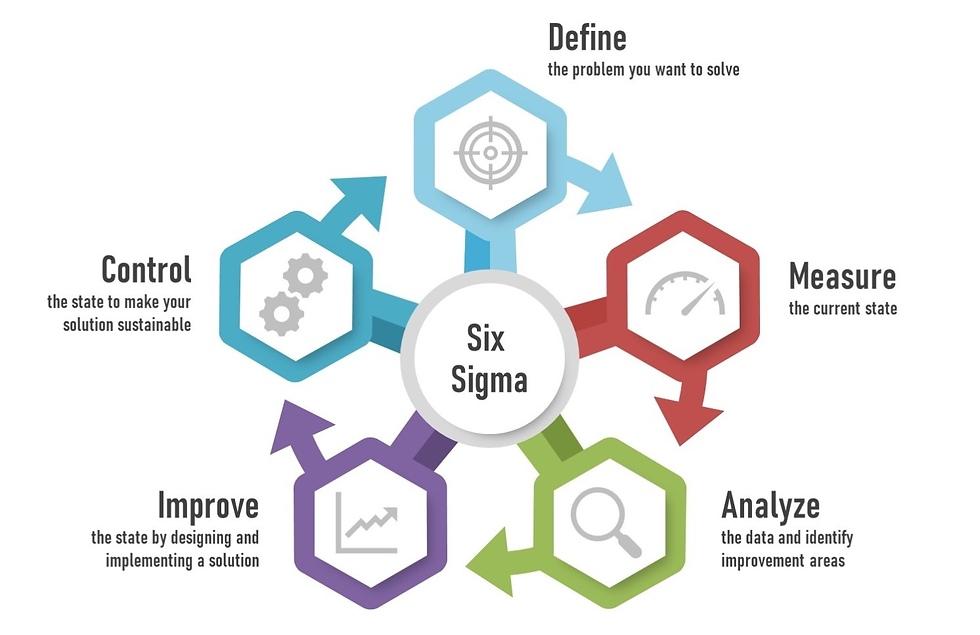
DMAIC in action
Once again, there are processes, tools and techniques that can help you tackle every stage of DMAIC, some of which you will certainly have used before: customer interviews, cause-and-effect diagrams, Gantt charts, Pareto charts, sampling, stakeholder analysis, benchmarking, value stream maps, gap analysis… The list goes on, and selecting the right tool for the right job is vital.
It’s also important to consider the aspect of scale. You could tackle org-wide issues with buy-in from your most senior stakeholders; work with your peers across a couple of departments or product lines; or focus on only solving problems that you have the complete authority to tackle.
In summary, whether you’re keen on continuous improvement, solving a single problem, or “optimizing the whole”, Six Sigma is an excellent approach to improve quality and efficiency, reduce process variability, minimize defects and increase customer satisfaction.
What do you think?
Connect with our experts to set up a workshop that suits your needs.


Comments